
AI Vision RFID Library Management System with Modbus Integration
In this article, you will learn:
· What is AI Vision RFID Library Management System?
· How does Modbus integration work in this system?
· What are the key benefits for building automation?
Click any topic above to jump directly to that section.
Modern library management has evolved beyond simple book checkout systems. With AI vision and RFID technology, libraries can automate inventory tracking, prevent theft, and monitor visitor flow in real time. But the real value increases when this system integrates with building automation — especially HVAC control.
AI Vision RFID Library Management System combines computer vision and UHF RFID technology to track books, manage inventory, and monitor entry/exit gates. It captures real-time data on borrowed items, returned books, and misplaced stock through handheld UHF readers and overhead RFID ceiling readers.
What is AI Vision RFID Library Management System?
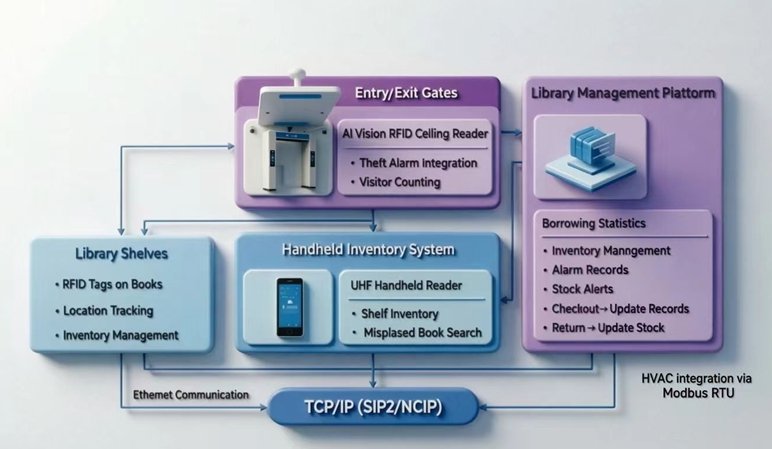
This system consists of four key components. At the entry and exit gates, an AI Vision RFID Ceiling Reader detects tagged items passing through, triggering theft alarms when needed and counting visitor numbers. On the library shelves, RFID tags on books enable location tracking and real-time inventory management. Librarians use a UHF handheld reader for shelf inventory and misplaced book searches. All data flows to a central Library Management Platform that tracks borrowing statistics, inventory levels, alarm records, and stock alerts. The platform communicates via Ethernet using TCP/IP and standard library protocols like SIP2 or NCIP.
How does Modbus integration work in this system?
While RFID handles asset tracking, Modbus integration connects the library system to the building’s HVAC network via RS485 communication. When the library management platform detects a change in occupancy — such as a sudden increase in visitor count at entry gates or a decrease during off-hours — it can send a command over the Modbus network to adjust temperature setpoints in specific zones. Our Modbus thermostats, for instance, can receive these commands and adjust zone temperatures accordingly.
For example, during peak hours, the system signals the HVAC controller to switch to comfort mode (22°C) in occupied reading areas. During low-traffic periods, it triggers energy-saving mode (18°C) to reduce power consumption. This integration uses standard Modbus RTU function codes, making it compatible with most building automation systems without requiring custom gateways.
What are the key benefits for building automation?
Integrating AI Vision RFID with Modbus-enabled HVAC control offers three main advantages for building automation.
First, energy efficiency improves by coordinating occupancy data from the library system with HVAC schedules. The system automatically adjusts temperature based on actual usage patterns, avoiding unnecessary cooling or heating during empty hours.
Second, operational costs decrease because the building management system receives real-time occupancy updates directly from the library’s RFID network. This eliminates the need for separate occupancy sensors, reducing hardware and installation expenses.
Third, data centralization consolidates library management, HVAC control, and access monitoring onto a single platform. Facility managers can view both inventory status and zone temperature from one dashboard, simplifying troubleshooting and reporting.
For facility managers and system integrators, this integration creates a practical pathway toward smarter building operations — combining asset tracking with environmental control through a single RS485 bus.
Recommended Reading:
· How to Set Up RS485 Communication for Modbus Thermostats (coming soon)
· Modbus Thermostat in Fan Coil Unit Systems: A Typical Application (coming soon)
· Smart Thermostat Selection Guide for HVAC Projects (coming soon)
For more technical guides and product information, browse our blog or contact our engineering team for a free consultation.