
What is Modbus RTU and How Does It Work in HVAC Systems?
In this article, you will learn:
How does Modbus work in HVAC systems?
Which thermostats support Modbus communication?
How to choose the right Modbus thermostat for your project?
Click any topic above to jump directly to that section.
If you work with HVAC systems, you have probably heard the term “Modbus” thrown around. But what exactly is it, and why does it matter for temperature control?
What is Modbus RTU?
Modbus RTU is a serial communication protocol widely used in building automation. It allows devices like thermostats, sensors, and controllers to communicate with each other over long distances using twisted-pair wiring. In HVAC applications, Modbus RTU enables centralized monitoring and control of temperature, humidity, and fan speed across multiple zones. (Source: Modbus.ORG)
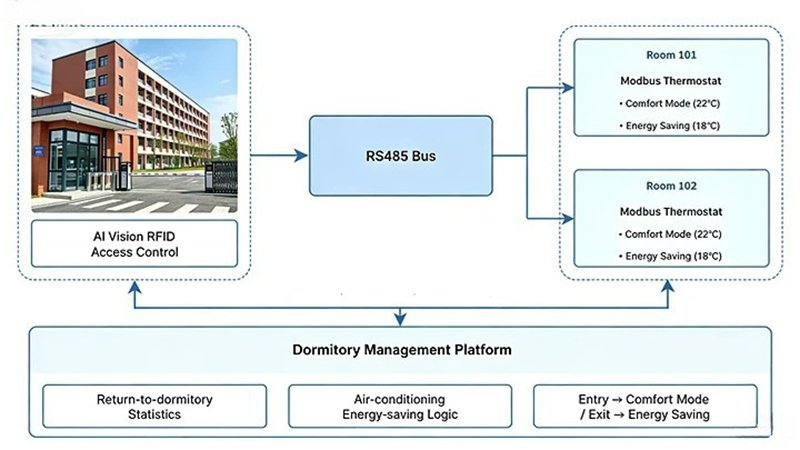
One of the key reasons Modbus RTU is preferred in HVAC systems is its simplicity and reliability. It uses a master-slave architecture, where one master device (like a building management system) communicates with multiple slave devices (like thermostats or valve controllers). Each slave device has a unique address, and the master polls them in sequence to read or write data.
For example, a Modbus thermostat in a fan coil unit can report the current room temperature to the building management system. The system can then send a command back to adjust the setpoint or control the valve position. This two-way communication makes Modbus RTU ideal for energy management and remote troubleshooting.
RS485 is the most common physical layer for Modbus RTU. It supports cable runs up to 1200 meters and allows up to 247 devices on a single network. In a typical commercial building, RS485 wiring connects thermostats, sensors, and controllers throughout the floors, all feeding back to a central hub.
How does Modbus work with HVAC systems?
For installers and system integrators, Modbus RTU is straightforward to implement. Each device needs its baud rate, parity, and stop bits configured consistently. Once the network is set up, it requires minimal maintenance and provides years of stable operation.
Which thermostats support Modbus communication?
At the component level, Modbus RTU thermostats like the 8911RHKLD series come with built-in RS485 interfaces and support standard Modbus function codes. This makes them compatible with most building automation systems without requiring proprietary gateways or custom software. For full specifications and wiring diagrams, visit our product page.
Related: Learn how to set up RS485 communication for Modbus thermostats. (coming soon)
How to choose the right Modbus thermostat for your project?
If you are designing a new HVAC system or retrofitting an old one, Modbus RTU remains one of the most cost-effective and proven communication solutions in the industry. Its widespread adoption means you will find support, documentation, and compatible devices easily available.
Recommended Reading:
How to Set Up RS485 Communication for Modbus Thermostats (coming soon)
Modbus Thermostat in Fan Coil Unit Systems: A Typical Application (coming soon)
Smart Thermostat Selection Guide for HVAC Projects (coming soon)
For more technical guides and product information, browse our blog or contact our engineering team for a free consultation.