How to Choose a Modbus Thermostat for Your HVAC Project
In this article, you will learn:
- Why Choosing the Right Modbus Thermostat Matters
- Water System FCU vs. VRF: Matching Your Existing Setup
- Key Specs: 2-Pipe vs. 4-Pipe Compatibility
- Modbus Addresses and Register Settings
- Selecting the Right Model for Your Retrofit Project
- What to Verify with Your Supplier Before Ordering
If you are wondering how to choose a Modbus thermostat for your next project, this guide will walk you through the key factors.
In commercial HVAC projects, how to choose a Modbus thermostat is not just about picking a device that fits the wall. It requires a deep understanding of your existing system architecture, communication protocols, and retrofit constraints. A wrong choice can lead to BMS integration failures, higher labor costs, and unhappy tenants.
Why Choosing the Right Modbus Thermostat Matters for Retrofit Projects
Many office buildings constructed in the 1990s and 2000s still rely on standalone FCU thermostats. When facility managers decide to upgrade to a Building Management System (BMS), replacing these standalone units with a Modbus thermostat is the most cost-effective first step.
However, older buildings often have unique wiring setups. If you choose a thermostat that doesn’t support your existing valve types or fan motor, you’ll face expensive rewiring costs. The right thermostat bridges the gap between old equipment and modern controls without requiring a full HVAC renovation.
Water System FCU vs. VRF: Matching Your Existing Setup
This is the biggest trap in HVAC retrofits. You must identify whether your system is a water-based Fan Coil Unit (FCU) or a VRF (Variable Refrigerant Flow) system.
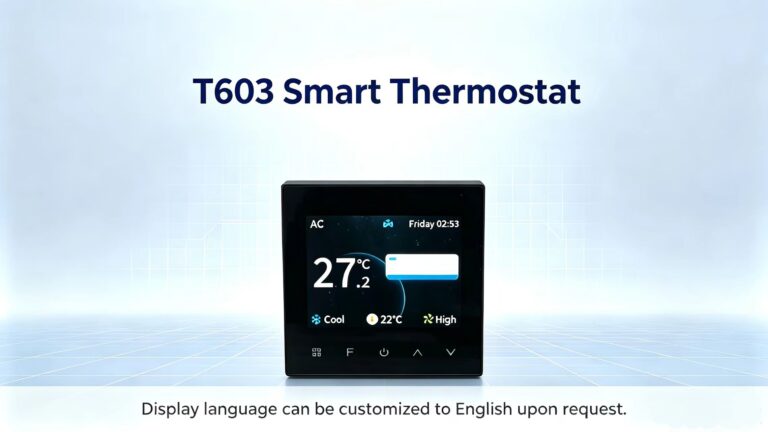
- Water System FCU: A standard Modbus thermostat (like our T603) can be wired directly to the fan and valve actuators using RS485 for BMS integration. It does not need a gateway.
- VRF Systems: A Modbus thermostat cannot directly control a VRF outdoor unit. It must connect via a dedicated VRF gateway.
The 2-Wire vs. 4-Wire Trap (Critical!):
Do not assume a VRF system is compatible just because the old wall thermostat has 2 wires. The physical wire count (2-wire F1/F2 or 4-wire R1-R4) is just the physical layer. The actual communication protocol (“language”) is determined by the outdoor unit.
To integrate with VRF, you must:
- Get the outdoor unit model number to identify the protocol.
- Purchase a VRF-specific to Modbus RTU gateway. (Note: A standard Modbus gateway cannot communicate with VRF multi-unit systems.)
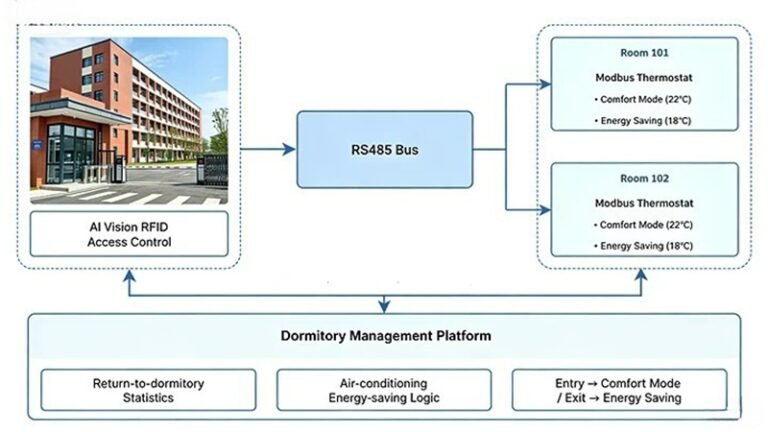
- Connect the VRF-to-Modbus gateway and Modbus thermostats to the same RS485 daisy-chain bus. Both devices act as Modbus slaves.
⚠️ Important: A BMS/PLC (Modbus Master) is required to manage this bus. T603 thermostat cannot directly control VRF units. It can only be controlled by the BMS master. For projects without a BMS, this setup will not work for VRF control.
Key Specs: 2-Pipe vs. 4-Pipe Compatibility
For water-based systems, the thermostat must match the piping and valve configuration.
| Feature | 2-Pipe System | 4-Pipe System |
|---|---|---|
| Valve Control | Typically On/Off valves | Can use On/Off valves (basic) or 0-10V modulating valves (high-precision) |
| Fan Control | 3-speed AC fan or EC fan | 3-speed AC fan or EC fan |
| Thermostat Requirement | Must support 2-pipe logic | Must support 4-pipe logic (Cool/Heat switching) |
Before buying, confirm if the existing valves are On/Off (standard) or 0-10V modulating. Note that standard models like the T603 support On/Off valves ONLY. They do NOT support 0-10V modulating valves. For 0-10V applications, you need a different model.
3-speed AC fans do not require VFDs. The VFD/EC fan scenario applies only to EC fans that need 0-10V speed control.
Modbus Addresses and Register Settings
Understanding Modbus addressing is crucial for a smooth BMS integration. If you are also integrating a VFD for fan speed control, you will need to read the specific VFD manufacturer’s register map (e.g., Danfoss VFD Modbus register addresses).
When commissioning, ensure all devices on the RS485 bus use identical communication parameters.
| Parameter | Standard Value |
|---|---|
| Baud rate | 9600 bps |
| Data bits | 8 |
| Stop bits | 1 |
| Parity | None |
| Modbus address | 1-247 (Unique per device) |
Note: “Module address” and “Modbus address” are often used interchangeably. Always set a unique address for each thermostat on the bus. Address 0 is reserved for broadcast and should NOT be used for individual devices.
Selecting the Right Model: How to Choose a Modbus Thermostat for Your Retrofit Project
Based on your project requirements, here is a simple selection matrix:
| Model | Best For | Key Features |
|---|---|---|
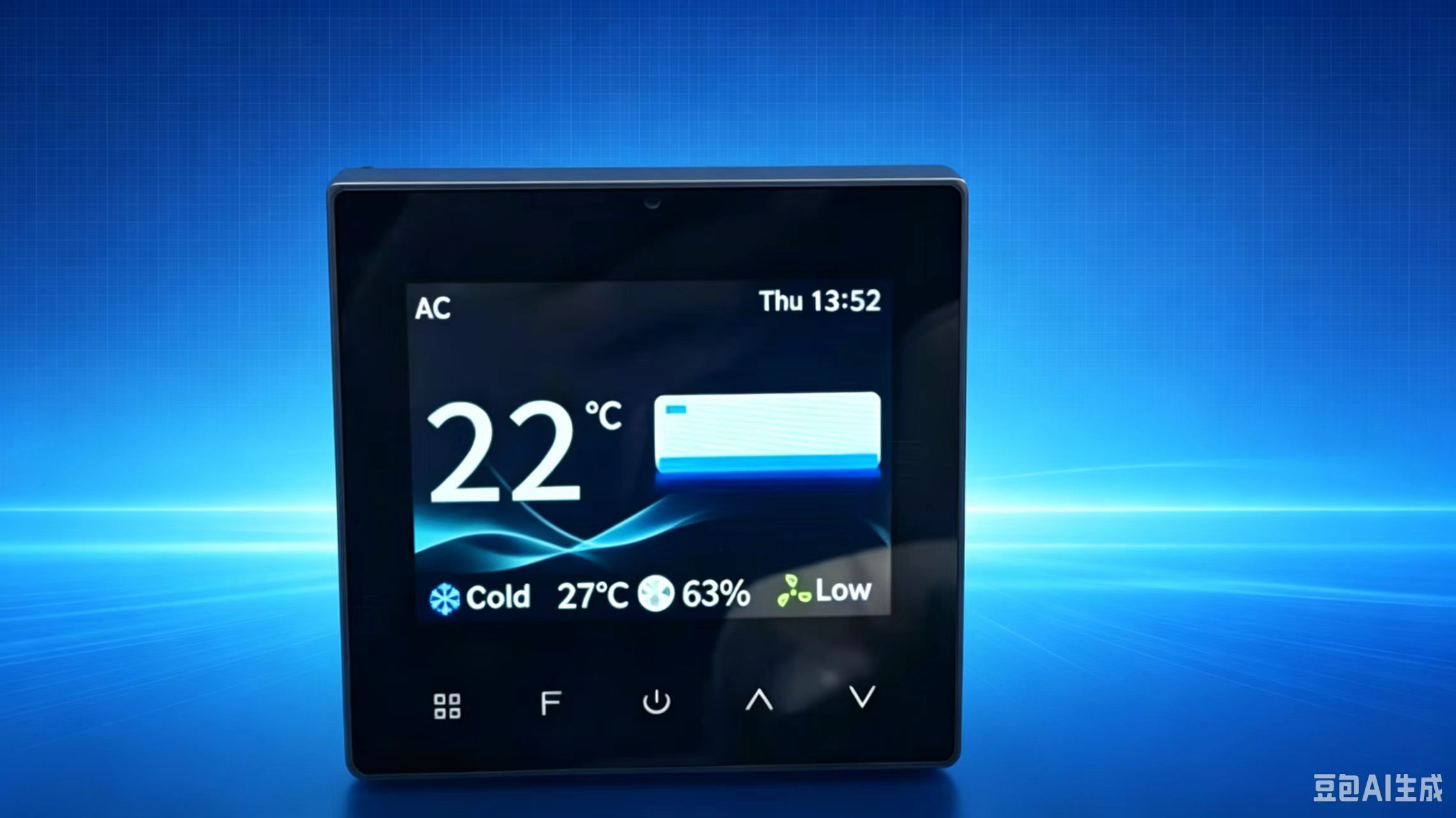
| T603 | Standard Office/Hotel FCU Retrofit | 86x86mm, TFT Display, RS485 Modbus RTU, On/Off Valve, 3-speed Fan |
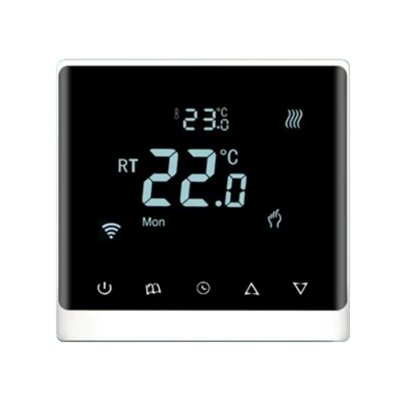
| T605 | Advanced FCU or Underfloor Heating | Similar to T603, optimized for heating/cooling applications |
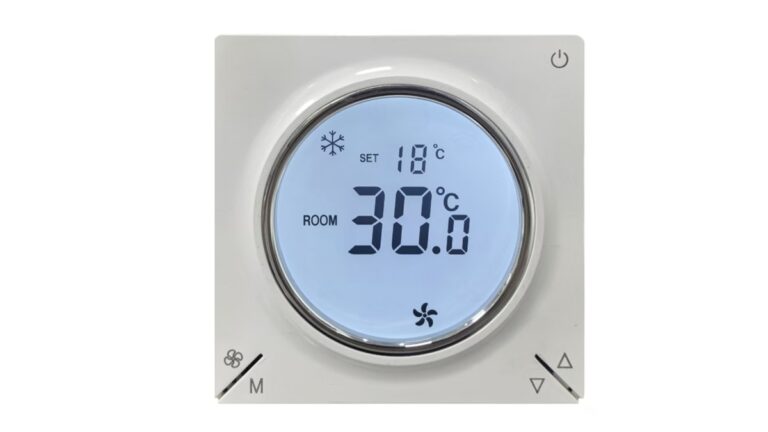
| 8806F / 8802XF | Fresh Air / Specific Fan Coil Applications | Specialized form factors and control logic |
| 8818H / 8819 | Direct Replacement for legacy systems | Can directly replace old thermostats ONLY IF the wiring definitions match. |
What to Verify with Your Supplier Before Ordering
To avoid site integration failures, check these points before finalizing your order:
- □ Is your system 2-pipe or 4-pipe?
- □ What is the existing valve type? (AC/DC, 24V or 230V, On/Off)
- □ Is the fan motor a standard 3-speed AC type?
- □ For VRF: Have you confirmed the outdoor unit model and sourced the correct VRF-specific Modbus RTU gateway? (Note: Standard Modbus gateways will NOT work.)
- □ For OEM projects: Do you need customized English terminals or specific firmware?